
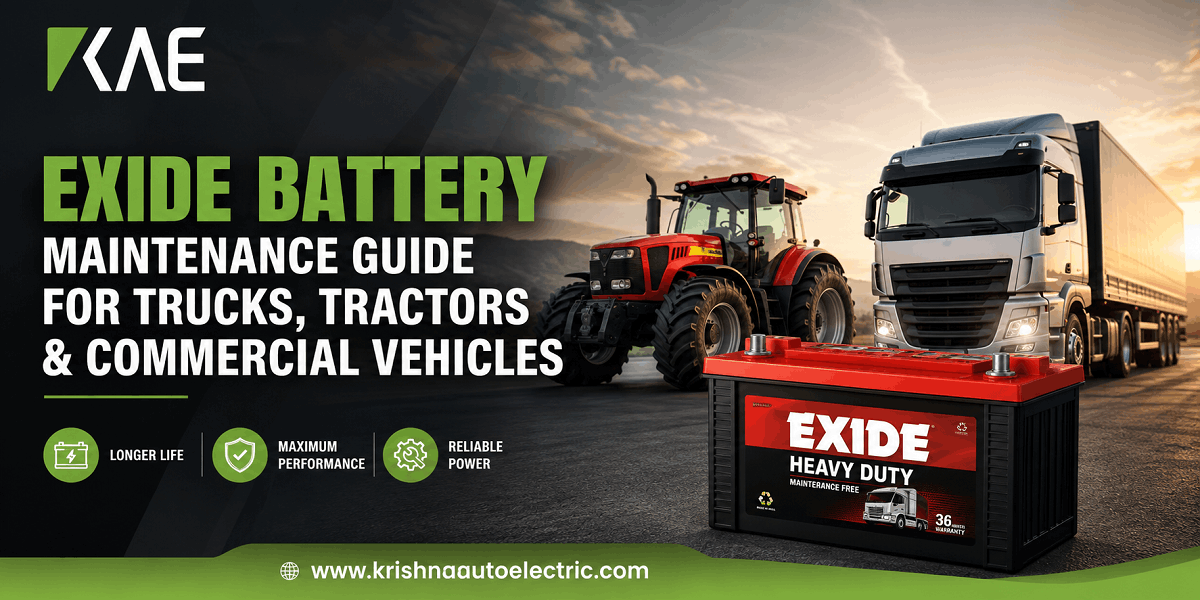
Maintaining a truck, tractor or commercial vehicle battery means checking terminal connections for corrosion monthly, testing resting voltage (12.4–12.6V for a healthy 12V battery), keeping the case and mounting secure against vibration, and testing the battery before every season change. Most battery failures in commercial and farm vehicles trace back to loose or corroded terminals, not a faulty battery itself.
This matters more for trucks and tractors than for passenger cars because they run longer duty cycles, sit through more vibration on rough roads and open fields, and often carry heavier electrical loads — lights, hydraulics, cabin electronics and, in fleet trucks, telematics units that keep drawing current even when the vehicle is parked. A battery that would comfortably last four to five years in a hatchback can fail in half that time in a tractor or truck if nobody’s checking it.
Why Trucks, Tractors & Commercial Vehicles Punish Batteries Harder Than Cars
A passenger car battery mostly deals with short daily trips, smooth tarmac and a predictable electrical load. Commercial and farm vehicles rarely get that easy a life:
- Vibration — unpaved roads, field terrain and constant engine vibration gradually loosen terminal clamps and battery hold-downs. A connection that was tight in January can be rattling by June.
- Heavier starting loads — diesel engines, common in trucks and most modern tractors, need higher cranking amperage to turn over a higher-compression engine than a petrol car does, especially on a cold morning.
- Longer parked/idle periods — a fleet truck sitting overnight with a telematics unit or tracker running, or a tractor parked for weeks in the off-season, both draw a small but steady current that can flatten an unmonitored battery.
- Heat and dust exposure — Ahmedabad and much of Gujarat regularly cross 40°C in summer. Heat accelerates water evaporation inside the battery and speeds up internal corrosion; dust building up on the case can create a light current leak across the terminals.
The table below is a quick way to see where your own vehicle sits on that risk scale — and how often it realistically needs a battery check.
| Vehicle Type | Typical Duty Cycle | Vibration Exposure | Recommended Check Frequency |
|---|---|---|---|
| Passenger car | Short daily trips, mostly tarmac | Low | Every 3–4 months |
| Truck / commercial fleet vehicle | Long-haul or multi-stop daily routes, frequent idling | Moderate–High | Monthly, plus every long-haul departure |
| Tractor | Heavy field use in season, long idle periods off-season | High (field terrain) | Monthly in-season; before and after off-season storage |
The Monthly Battery Maintenance Checklist Every Fleet & Tractor Owner Should Follow
None of this requires special equipment beyond a wire brush and a basic multimeter, and the whole routine takes under ten minutes once it’s a habit.
1. Terminal & Connection Check
- Switch off the vehicle and let it sit for a few minutes before touching the battery.
- Look for a white or greenish crust around the terminals — this is corrosion, and it’s the single most common cause of hard-starting complaints we see.
- Clean any buildup with a wire brush or a terminal cleaning tool; a stiff toothbrush works in a pinch.
- Check that both terminal clamps are tight by hand — a clamp that shifts under light pressure needs tightening.
2. Voltage & Load Testing
With the engine off, a healthy 12V lead-acid battery should read 12.4–12.6V on a multimeter. Anywhere below 12.2V means the battery is significantly discharged and needs charging or investigation before it’s relied on again. If you have access to a load tester, a battery that holds voltage under load is fine; one that drops sharply is nearing the end of its usable life even if the resting voltage looks acceptable.
3. Physical Inspection
Check the battery case itself for cracks, bulging or leakage — any of these mean the battery needs replacing, not just servicing. Confirm the hold-down bracket is still snug; on tractors and trucks running rough terrain, this is one of the first things vibration works loose. Wipe dust and grime off the case, since a dirty, damp surface can create a slow current leak between the terminals.
4. Seasonal Adjustments for Gujarat Conditions
Before summer, check water levels on any battery that isn’t fully sealed, since evaporation speeds up sharply above 40°C — top up with distilled water only, never tap water. Before the monsoon, make sure terminal connections are properly sealed against moisture, since damp corrosion sets in faster than dry corrosion. If a tractor is going into off-season storage, either disconnect the battery or keep it on a trickle charger — a battery left connected and unused for months is one of the most common causes of a “won’t start” call once the season begins again.
Spotting Battery Trouble Before It Strands You
Most battery failures give some warning before they cause a full breakdown — the trick is knowing what to watch for.
- Slow or clicking crank — the engine turns over sluggishly, or you hear a single click instead of the starter engaging. Usually points to a discharged or weakening battery.
- Dim headlights or dashboard lights — especially noticeable at idle, this can indicate either a weak battery or a charging problem.
- Swollen or warped case — a battery case that’s visibly bulged has likely been overcharged or exposed to excess heat, and should be replaced rather than serviced.
- Repeated jump-starts — needing a jump more than once in a short period is a sign the battery isn’t holding charge, not a sign that jump-starting is a fix.
It’s worth being clear about one thing: a weak battery and a failing alternator or starter motor often look identical from the driver’s seat, and treating the wrong one delays the real fix. If you’re trying to work out which component is actually at fault, our detailed breakdown on diagnosing a truck battery or alternator problem walks through the exact tests to run, and our guide on telling a starter, alternator and battery fault apart covers the same logic for cars and light vehicles.
How Long Should an Exide Battery Last — And When Should You Replace It?
Under normal Indian road and field conditions, a well-maintained battery in a truck, tractor or commercial vehicle typically lasts 3 to 5 years. Where it lands in that range depends on four things: how many deep-discharge cycles it goes through, whether the charging system (alternator/regulator) is keeping it topped up correctly, how much heat and vibration it’s exposed to, and how consistently it’s checked and cleaned.
Age alone isn’t the best signal — a 3-year-old battery that’s been neglected can fail before a well-maintained 5-year-old one does. Treat these as replacement signals regardless of the battery’s age:
- It needs a jump-start more than once in a month
- Resting voltage stays below 12.2V even after a full charge
- The case shows cracking, swelling or visible leakage
- Cranking is noticeably slower on cold mornings than it was a few months ago
Exide’s range covers this exact spread of use cases — four-wheeler and light commercial vehicle batteries, tractor and Genet batteries built for field duty, and inverter batteries for backup power — all built on sealed, maintenance-reduced construction that resists spillage and corrosion better than older battery designs. You can see the full range of Exide batteries we stock, matched to vehicle type and usage.
DIY Care vs. Professional Service — And Choosing the Right Battery
Cleaning terminals, checking voltage, tightening hold-downs and keeping the case clean are all safe for an owner or driver to do without special training. A few things are worth leaving to a professional: load testing under actual working conditions, diagnosing whether a repeated battery drain is coming from the battery itself or from a charging system fault, and any work involving a swollen or leaking case, since damaged batteries can release corrosive material. If your battery keeps discharging even after a full charge, the issue is often on the charging side rather than the battery — our Delco Remy alternator range covers replacement parts when that turns out to be the real cause.
Choosing the right battery matters as much as maintaining it. A tractor working long field hours needs a battery built for repeated deep discharge and vibration, not a standard car battery pressed into service because it happened to fit. A long-haul truck running overnight halts benefits from a battery sized for both high cranking amperage and steady auxiliary load. Our team can match the right Exide battery to your vehicle and usage pattern — the current Exide price list is a useful starting point if you’re comparing models before visiting the store. And if you’re already sourcing genuine tractor spare parts from us, it’s worth getting the battery checked in the same visit — it’s one less separate trip.
Battery maintenance for trucks, tractors and commercial vehicles isn’t complicated, but it does need to be consistent — a five-minute monthly check catches almost everything that would otherwise turn into a roadside breakdown. Know the three things that matter most: clean, tight terminal connections; a resting voltage you actually check rather than assume; and replacement signs you act on before they turn into a stranded vehicle. Whether you’re running a single tractor or a small fleet, that habit is what separates a battery that quietly does its job for five years from one that fails without warning at the worst possible time.
Frequently Asked Questions
How often should I check my truck or tractor battery?
Check terminals, voltage and physical condition at least once a month. Trucks running long-haul routes and tractors in active field use should be checked before every extended trip or before the start of each farming season, since both vibration and duty cycle accelerate wear.
Can I use a regular car battery in a tractor or commercial vehicle?
Not recommended. Tractors and commercial vehicles need batteries built for higher vibration tolerance and deeper discharge cycles than a standard passenger car battery is designed for. Using the wrong battery type usually shortens its life significantly, even if it physically fits.
How do I know if my Exide battery needs replacement?
Repeated jump-starts, resting voltage below 12.2V after a full charge, a cracked or swollen case, or noticeably slower cranking on cold mornings are all clear replacement signs, regardless of the battery’s age.
Why do tractor batteries drain faster than car batteries?
Tractors sit unused for longer off-season stretches, run through more vibration on field terrain, and often power accessories like lights and hydraulics while the engine idles — all of which draw down charge faster than typical passenger car use.
Do Exide batteries need water top-up?
Most Exide automotive and commercial vehicle batteries use sealed, maintenance-reduced construction and don’t need regular water top-up. Always check your specific battery model’s markings, and if top-up is needed, use only distilled water.
Where can I buy genuine Exide batteries for trucks and tractors near Ahmedabad?
Krishna Auto Electric is an Exide battery distributor based on Sarkhej-Sanand Road, Ahmedabad, stocking batteries for trucks, tractors, commercial vehicles and inverters, along with the tractor and auto-electrical spares to go with them.
Get Your Battery Checked at Krishna Auto Electric
If it’s been more than a month since anyone looked at your truck or tractor’s battery, that’s reason enough to stop by. Our team at Krishna Auto Electric stocks the full Exide range for trucks, tractors and commercial vehicles, and can test your existing battery on the spot rather than guess.
Visit us: Krishna Auto Electric / Krishna Distribution House, 438/2, Near Orange Hotel, Sanand, Ahmedabad, Gujarat 382210
Call for auto spares: +91-97124-63530 / +91-84889-68382
Call for tractor spares: +91-97120-63530 / +91-97124-63530
Email: krishnaautoelectric@yahoo.com
Working hours: Mon–Sat, 9:00 AM – 6:30 PM